Showing posts with label 1st Doctor. Show all posts

Tuesday, 4 March 2014

The Space Museum Review

The Space Museum: "The least important things, sometimes, my dear boy, lead to the greatest discoveries."

I came to this story having heard it had a good first episode and then it went downhill from there. It seems a lot of stories start of with a great first episode, I often find myself giving them 8s and 7s, and usually the quality does diminish after this in varying degrees. And The Space Museum was no exception, though it steadily gets worse rather than a sudden drop.

It does start with a great first episode, slowly building up the fact that the travelers are basically invisible to everything but themselves. Not even leaving footprints in the sand. This then accumulates when the TARDIS crew find themselves in glass cases, just another exhibit in the museum. The Doctor declares that this is their future unless they somehow prevent it. It's a great twist and idea, one that continues throughout the story. Sometimes it gets shoved down our throat a bit too much, but generally the idea works well and is a new element to the show.

The next episode is good as well. It introduces the Morox and the Xerons, both species supposedly alien. This is illustrated by the Morox's ridiculous hair line and hair colouring and the Xerons' weird bigger eyebrows. Drawn above their real and highly visible eyebrows. The design of  the aliens aren't great and neither are the stories of these aliens. The Morox invaded Xeron and took control of the planet. The Xeron went into hiding but have wanted to overthrow the Morox ever since. So far so good. But neither species are very well realised (bad ascetics aside); the Xerons haven't revolted yet because they lack any armaments to do so. That's really the only reason given. Whilst the Morox are supposed to be militaristic,  but aside from the leader Lobos (you might have noticed that the names in this story aren't very inventive either) they don't seem very oppressive. They are easily fought off at the end of the story and Ian is able to fight one and threaten him easily. As soon as Ian has the gun the Morox becomes a whimpering idiot.

As I mentioned before the leader of the Morox, Lobos, is a lot better developed. He seems quite cruel and cunning and the scenes in which he interrogates the Doctor are brilliant. If only because of the way the Doctor has fun with the visualising machine and we get to see an odd picture of him in a bathing suit and top hat...

The way the story concludes is good as well, with the Xerons finally revolting against the Morox due to the influence Vicki has left on them. It's nice to see after the travelers constant talking of how they need to change their own future that it's not how they change it but how others change it due to their impact.

Vicki gets some good scenes and even a hint of romance with a young Jeremy Bulloch. Vicki really is a much better character than Susan.

Episode scores:
1. The Space Museum: 8/10
2. The Dimensions of Time: 7/10
3. The Search: 6/10
4. The Final Phase: 4.5/10

Average score: 6/10

Next up The Chase.

Monday, 3 March 2014

The Crusade Review

The Crusade: "There's something new in you, yet something older than the sky itself."


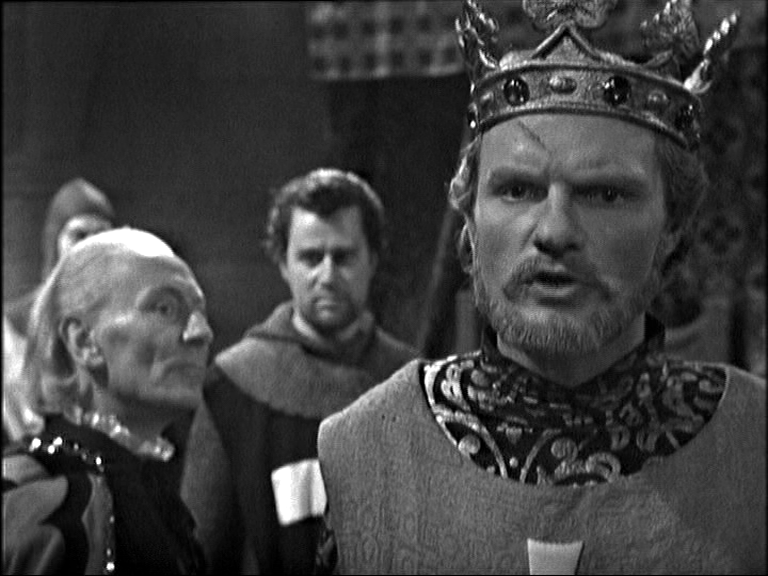
Julian Glover! I knew he was in City of Death but I never knew he was in Doctor Who before that, and not during William Hartnell's era. So it's a shame that two episodes from this story. Even more so because it's only a four parter (if it was a six or more it would still be a shame but at least most of the story would be surviving) and because it's really good. At least the surviving episodes are (episodes one and three). The last episode is a bit rushed really and is probably the weakest. The audio for the missing episodes survive but it's not very good quality and I found it hard to understand at times what characters were saying. At least we have the audio, but still.

Anyway onto the actual story. The dialogue in this is brilliant, very flowing and eloquent. Especially in episode three, The Wheel of Fortune, when the Doctor argues with the Earl of Leicester and when King Richard and his sister Joanna argue over her marriage. Both arguments, I wonder what that says? Julian Glover and Jean Marsh really play that scene well.

There is a fair bit of action mainly in the first episode in the first few minutes. As soon as the TARDIS crew enter we start right in it and we get some good fighting scenes. The Doctor evens picks up a sword. Even after The Romans, in which the Doctor laughed his way through a fight, I'm still surprised by this.

There isn't much more to say about this story other than there are some great scenes in it and the ending is a bit rushed. It might have actually have benefited from being a six parter. Or at least a fiver parter. Speaking of which why was there never a five parter? Stories of fours and six episodes became standard but six could often be overlong or suffer from too much padding. Whereas four part stories could often be a bit rushed. I can't be the only one who thought of finding the exact middle point between the two before. Especially at this point when the standard story length wasn't quite nailed down. Ah well.

Episode scores:
1. The Lion: 8/10
2. The Knight of Jaffa: 6.5/10
3. The Wheel of Fortune: 8/10
4. The Warlords: 6/10

Average: 7/10

Next up is The Space Museum.

Sunday, 2 March 2014

The Web Planet Review

The Web Planet: "Zaaaaarrrr-bbbbbbiiiiii"

I came into The Web Planet not really knowing what to expect, I certainly wasn't expecting that! Dear God!

I started, as I always try to, hoping for the best and trying to see the best in it. The first episode I actually thought was really good. It was mysterious, and like most of the first episodes of this era, only had the TARDIS crew. The Zarbi appeared and I did balk. I'd see pictures of them before but never really seen the legs. But the Zarbi were only seen for a little bit and I put them to the side. Instead I focused on the Doctor back in full exploring scientist mode and the great scenes of continuity with Barbara and Vicki. They talk about school and they really show the differences between Barbara's 1960's teaching methods to Vicki's 25th century learning. It's a nice little touch that shows that Vicki really is from the 25th century.

After the first episode though I soon lost the plot. I couldn't handle the Zarbi, the Menoptera and then later the Optera.

I've been trying to think what is wrong with this and whether it doesn't work because of the time that it was made in and with the money constraints. But if they tried to make this in modern who the costumes and/or CGI would look just as ridiculous. The Menoptera are actually pretty well designed and realised. The weird gestures that they all make really shows that it's an alien race, not just a guy (or girl as is the case here) in a suit. Even the voice show you just how alien this species is. I think by the time I finish this marathon I won't have come across any alien in the show that is as alien as the Menoptera. Even the Optera are well designed, and try to be like the Menoptera in having weird movements and voice. The Zarbi shells aren't that bad, it's just that there is a (comparatively) giant pair of legs sticking out of them. I made have found the beeps that they make bloody annoying, but again it all works to show that these are aliens that don't understand humans in anyway.

So if all of these things are actually quite good and effectively show the alien-ness of Vortis and it's inhabitants what is wrong with story? I want to say it's because it's so alien and that there are only the four recognisable faces in the story. As far as I know this is the only Doctor Who story, new and old, that has completely alien characters other than the TARDIS crew. The only other story I can think of that has all 'aliens' is The Daleks. In that we had the Daleks and the Thals, but that doesn't count because the Thals are basically humans.
But surely if the aim is to have everything alien then The Web Planet is a triumph as it achieves that? Perhaps we reject the story because everything is alien and we can't handle it so we just resort to laughing at how ridiculous everything looks?

I honesty couldn't say. I am only suggesting these points. The phrase 'ambitious' is often banded are in relation to this story, and perhaps it is just too God damn ambitious for it's own good. But I can't really think of how this story could ever work. Or maybe Bill Strutton was just trying to alienate the audience and if he were alive today (he died on 23rd November 2003) he would be laughing at how no one can handle his story.

All I can say is that The Web Planet defeated me. I've given each episode a score, as always, but I almost think it's not fair to do so. What ever Bill Strutton intended audiences to take from this story I don't posses the intelligence, or whatever is needed, to do so. I don't think you can fairly give a rating to something you didn't understand but there you have it.

Episode scores:
1. The Web Planet: 8/10
2. The Zarbi: 4/10
3. Escape to Danger: 4/10
4. Crater of Needles: 4/10
5. Invasion: 2/10
6. The Centre: 2/10

Average score: 4/10

Next time is The Crusade and my second foray into recons.

The Romans Review

The Romans


Again another first time watch for me (up until The War Machines as the end of season three, the stories will all be new for me). I heard it was good and that it was a sort of comedy. That's pretty much all I knew going in.

Whilst watching this story I had to write down this quote from the Doctor: "You know, I am so constantly outwitting the opposition, I tend to forget the delights and satisfaction of the gentle art of fisticuffs." The first Doctor said that! Right after he giggled his way through a fight. Which brings me onto my next point; the Doctor has been reminding me of Yoda in Return of the Jedi recently with his giggling all the time. It's something that just seems to have evolved in the last few episodes and carries on for a while (I'm part way through The Crusade story whilst writing this). It's completely different to the man we saw in An Unearthly Child, and not an aspect of this Doctor that I've really seen before. It's making me like him even more though.

The idea of making this historical as a comedy is brilliant and works really well here. Some of it's quite subtle, where other times it's outright silly, but in a good way. It took me a bit of getting used to at first, especially after possibly the best cliffhanger so far in The Rescue. The TARDIS materialises on a cliff edge, wobbles, then completely topples off. It's recapped at the start of this story, and I thought it was a great idea. Then next thing we're seeing the TARDIS crew all lying about having been there for a month.

It's interesting to see how the Doctor takes delight in having basically caused Nero's burning of Rome so he can rebuild it as he desires. If you think about it it's actually a bit out of character, people could easily die in the fire, and it would cause a lot of damage. All so Nero can rebuild it as he wants. Not something the Doctor should be so happy about. I choose to look at it as him realising that history is a bit more malleable than he first thought. In The Aztecs he made a big thing about how you couldn't change history, but here he is realising that that might still be true but it doesn't mean you can't influence it. Or in fact be the cause of history turning out how it does. It's and interesting dynamic show early in the show.

I've been thinking about this for a good while now but I've never been sure whether to bring it up or not but in reviewing this story I couldn't not. Ian and Barbara. I've always thought that they are very close and I've been reading what other fans say about it. But after watching this story it's no wonder that there is a comic in which they marry. They are far too friendly and playful in this story for something not to be going on between them at this point. I think it's nice that it's only heavily hinted, we never actually see them doing or saying anything to confirm this.

I am much preferring Vicki to Susan already. It's a case of better writing for her, less screaming (thank God) and, I hate to say this, better acting. She also seems a lot more upbeat and more companion material.

There isn't really much more to say about this other than I did enjoy it a lot.
Episode scores:
1. The Slave Traders: 7.5/10
2. All Roads Lead to Rome: 7/10
3. Conspiracy: 6.5/10
 4. Inferno: 7/10

Average score: 7/10

Next up The Web Planet...

Saturday, 1 March 2014

The Rescue Review

The Rescue


I went into this episode knowing practically nothing, except that it introduced new companion Vicki and that it was only two episodes long. Unfortunately I spoiled the twist in episode two for myself after watching the first episode and going on the TARDIS wiki to look something up. And there I saw Bennett listed as the villain. Dammit!

I'll never know if I would have figured it out or not. I'd like to think I might have got suspicious when Bennett wasn't in his quarters but I can't say for sure. Besides the twist is a bit wacky, especially when the two Didonas appear from nowhere and save the day. I was confused as to who they were, assuming they were crew members from the ship at first. I thought the Dido people looked like Koquillion?

Still it's not a bad story, a nice little filler and introduction to Vicki, who I've never seen before in action. She is obviously supposed to fill Susan's role but I like her, she seems different. A lot more energetic. And less screaming (so far). I really liked her interactions with the Doctor as well.

I think my favourite parts of the story are the interactions between the crew members. There's some great humour between them, they've been travelling together for a while now and they know each other well. I also like how the Doctor forgets Susan's not there for a moment as well. It shows it still has an effect on him, and the others are aware of it too. I just hope that the Doctor doesn't see Vicki as Susan's replacement and sees her as an actual person.

Episode score:
1. The Powerful Enemy: 7/10
2. Desperate Measures: 6/10

Average score: 6.5/10


Next up The Romans.

Friday, 28 February 2014

The Dalek Invasion of Earth Review

The Dalek Invasion of Earth


Again I've seen this story, and once again not that long ago. I started this marathon having seen the first three stories a few times before but not for a long while. Now I've started the second season having seen three in a row (though one was the end of last season), all for the first time and all recently. Just a strange coincidence.

The Daleks on Earth, in London, in front of Big Ben. Swarming around Nelson's Column. The team knew they were making iconic images when they did this. But when the shots of Daleks slowly trundling around are inter cut with fast paced shots of Barbara and Jenny pushing Dortmun along in his wheel chair it all becomes... a bit flat really. When you see those fast shots it's exhilarating , it's energetic, especially when accompanied by the constant drumming in the soundtrack. Then cut back to Daleks gliding along with the same music, which just becomes a bit annoying, and it doesn't really work. For me anyway, I'm sure there are plenty of fans out there who would shout their disagreements. I can see what they were going for, the Daleks menacingly gliding along famous locations in London is a great image in the photos, and when I imagined it my head, but the way it is edited together it just doesn't quite work. The same for the Dalek emerging from the water at the end of episode one and start of two. It's a brilliant idea, and it's done well. But there's something missing that stops it from being as epic a moment as it should be.

I found it hard to engage with the images, though the location shooting was great especially in the first episode, and I found it even harder to engage with the story. The Daleks have some rubbish dialogue in this and the whole idea of taking out the Earth's core so they can move Earth? What now? How now? And then they decided to blow it up instead. The fact that these ideas were reused in The Stolen Earth and Journey's End in modern Who just makes it worse. Oh and the Robomen are a good idea but are basically shit Cybermen.

The Daleks were really popular so they wanted to bring them back, fair enough, then they thought it would be a great idea to have them on Earth in London. Not to bad. But they forgot that they actually needed a decent story in there. Don't even get my started on the Slyther...

It seems like I really hated this story but I didn't, I just found it a bit boring, poorly executed and not as note worthy as people make out.

I did however love how they dealt with Susan's departure. It really was quite emotional and that speech from Hartnell is absolutely brilliant. I've seen that speech a few times now and I always liked it, but this time, having watched Susan and the Doctor's journey together, it meant even more than normal. Brilliant acting from Hartnell.

Episode score:
1. World's End: 8/10
2. The Daleks: 7/10
3. Day of Reckoning: 7/10
4. The End of Tomorrow: 5/10
5. The Waking Ally: 6/10
6. Flashpoint: 7/10

Average score: 6.5/10

Next up we get new companion Vicki in The Rescue.

Planet of Giants

Planet of Giants


Like The Reign of Terror I had watched this story not that long ago, probably in September of last year. It's an interesting story that's quite different to anything the show had done before it, or really since.

The story of the Doctor and co. being shrunken down to the size of an inch is rather fun and makes you think about everyday life. It is very well realised and I was amazed at how well my imagination went along with it and I really believed that they were climbing up onto a telephone whilst being no bigger than an inch.

This is all helped by the simply amazing props and sets. Everything is brilliant, from the fly, the match box and briefcase, and best of all the sink and plug hole. It's probably the best work seen on the show at this point. I think it helps that it's set on Earth and set at the time that it was made. It deals with things that people see in their everyday lives, so it has to meet up to people's expectations. The plug hole looks so good because they had to make it look like that, otherwise the audience would be taken out of the story and the illusion would be shattered.

Again it's all helped by some good direction too, from the slow pan out of the model TARDIS showing the garden path and house around it, to the very high angle shots of the Doctor and Susan in the sink, looking up. Especially good is the shot of the dead man and the miniature TARDIS crew looking up at his giant face. It is clear that's it a static image, but it does look massive, so it works.

Unfortunately the other story with the murder and the insecticide is a bit dull and bland for Doctor Who. It just doesn't really work with it. The whole thing with the operator realising that it was someone different on the phone is plausible but then her getting involved and calling the police is a bit of a stretch. Also who has a laboratory making seemingly top secret insecticide in a house? Not a very good business plan.

Also the Doctor wanting to start a fire? It never gets to that scale but he could have set the house on fire, maybe even killed people and caused massive damage. Seem a bit out of character to you?

I will say that the story being three episodes long was the perfect length for it though. And I'm noticing a pattern: Ian was sick in the Sensorites, Susan was ill in The Reign of Terror and now Barbara was ill in this story. Probably just a coincidence but seems a bit odd. Will the Doctor be next?

Episode scores:
1. Planet of Giants: 6/10
2. Dangerous Journey: 6.5/10
3. Crisis: 6/10

Average: 6/10

Next onto The Dalek Invasion of Earth.

Thursday, 27 February 2014

The Reign of Terror Review

The Reign of Terror


I watched The Reign of Terror either at the very end of last year or very early this year (I hadn't planned on doing this at that point and it was at my friend's, he had bought it recently) and I thought it was ok. I got a little confused by the French Revolution stuff (my friend had studied it in history so tried to fill me in, but it wasn't that helpful) and slightly bored but on whole it was alright. I loved Hartnell in his outfit, and I quite like the animations.

The truth is that I was right when I found The Reign of Terror a bit boring on my first viewing. My second viewing was no different. My main setback is that I no little about the French Revolution and to really follow the story you need to have at least a little knowledge. It's an unfortunate circumstance really. I imagine when this was broadcast in 1964 that children were being taught about the French Revolution so it would have been a great choice to do Doctor Who in this era. And when it was made the creators had no idea that it would ever be shown again, illustrated by the fact that two episodes of the story are missing. So as I said it's just an unfortunate circumstance, with no one really to blame.

A big problem is that there are a bit too many characters to keep track of, and this is made worse by the fact that half of them seem to be spies and turn out to be on different side to what you thought they were. Having someone the characters learn to trust only for them to be spies is fair enough, but this story has a bit too many. As well as that you don't really get a chance to see the character and see which side he is on before they turn out to be on the other side. As is the case with Léon, all we know of him is that he helped rescue Susan and Barbara and that he seems to like Barbara. That's pretty much it.

I think the best bits of the story are the Doctor and the costumes, which comes together when the Doctor dresses up as a ruler of a province (never named). The costume really is brilliant and Hartnell clearly has a lot of fun in it, and with ordering people about. His interactions with the jailer are a particular highlight and source of some good humour. 

Susan goes back to being pretty rubbish in the story unfortunately, becoming ill and being even more useless, which is a shame after her biggest role yet in the Sensorites the story before.

There really isn't much more to say about this story unfortunately, especially considering it's the season finale.

Episode scores:
1. A Land of Fear: 7/10
2. Guests of Madame Guillotine: 7/10
3. A Change of Identity: 7/10
4. The Tyrant of France: 4/10
5. A Bargain of Necessity: 4.5/10
6. Prisoners of the Concierge: 5/10

Overall average score: 6/10

I kick season two off with a look at Planet of Giants next time.

Tuesday, 25 February 2014

The Sensorites Review

The Sensorites

I went into The Sensorites with a bit of trepidation. I'd heard it was rather bad and very boring, really boring. It's like the opposite of of the Aztecs before it. I went into that having heard many a good word and hoping I would enjoy it as much as others seemed to have, with the Sensorites I was going in with as much positivity as I could, hoping it wouldn't be as bad as everyone said. So were the people right? Yes and no. It wasn't half as bad as people seemed to make it, but it did get quite boring at parts and by the end I was glad to be finished with it.

The first episode I actually really enjoyed. It was tense and mysterious with the seemingly dead bodies at the start with more information slowly being revealed. Possessed (or similar) John was quite scary and a bit discomforting and then you got the cliffhanger with the Sensorite outside the ship. The next episode was quite good, continuing the idea of the Sensorites being quite timid and not an aggressive race. Then episode 3 got rather boring. And from there it slightly picked up but only slightly, before going back down again.

One of the big let downs was that the Sensorites all looked too similar and they didn't have proper names to help, they were all just titles. The scientists were all just referred to as that, Scientist! The thing about them looking the same was used in the plot which I suppose is a good way to get round the design flaws but the audience has to keep track of multiple characters so it helps if we get some distinguishing features. At first the City Administrator was different because he was quite chubby (shows how similar they did look if I had to use weight for reference points) but then so was his side kick and it got a little confusing which was which at a few points. Luckily he had a voice that I could distinguish from the rest so I was never really lost, but there were a few times where I was in trouble of getting them mixed up.

I also feel that the City Administrator needed to be fleshed out a bit. We never really get a reason why he is so against the Humans. I get that their were humans there before (and some still there it turned out) and ever since then Sensorites had been infected by a disease (or so they thought) but none of the others were so opposed to the Humans. I suppose he was just racist (says the guy who just said they all look alike...) towards them and people can be like that, but it just seemed he was like that as there needed to be a bad guy in the story. It didn't help that he was just waved off at the end "oh the tampering with the maps proves he was guilty, we'll deal with him" after all the time we had spent watching him scheme.

Also the way the story handled Jacqueline Hill being on holiday wasn't great. At first it seemed quite well done, she was being left on the ship to look after things there, but then it became a matter of what was she doing up there? This was then made worse by the fact they kept mentioning bringing her back before doing so. I get that they were reminding us of her and introducing that she would be back again but it served to remind us of her absence. And then when she was back it was no big thing, one minute she wasn't there, the next she was and seemed to understand everything that was going on. I was barely keeping track of it all, never mind Barbara who hadn't been involved. They could have at lest tried to make her a fresh perspective on things, tell them that they were maybe judging events too harshly, as would have seemed in character. But she just blindly accepted what they told her and accepted that there was a bad guy, which lessens her character really.

The story started with the travelers reminiscing over all they've been through in this short time and them talking about how much they've changed. Susan seems surprised and asks "have I?" I was inclined to say no at first, that she hasn't really changed. But then we did get a touch of her becoming a better character in the Aztecs and in this story she really comes into her own. For the most part. She becomes the mid point between the Doctor and co and the Sensorites at the beginning, and we get a nice scene where she rebels against her Grandfather. She tells him that she's not just a little girl anymore and it really seems it. Earlier in the story when confronted by Possessed John she didn't even scream. Now that's got to be a big step up. I imagine this pleased Carole Ann Ford as (according to An Adventure in Time and Space, I think, as well as other sources) she was unhappy with Susan' character and wanted ore for her. Just a shame that it comes rather late. Still we get three more stories with her before she leaves, it's better now than in her last story.

I mentioned in my write up of The Aztecs that the Doctor has almost finished his transformation, and in this story I think we get to see the last parts of it. The Doctor not only comes up with an antidote but wants to stop what is causing the infection to the water supply. And he ventures into the sewers after his first escapade there to make sure everything gets properly sorted out. He is no longer the man who is eager to get back to the TARDIS and leave the caveman injured, or the Thals to their fight with the Daleks. He actively wants to help.

But then the we see him snap at Ian at the end of the story after a little joke. He may have changed a lot but it seems he can still snap back to he used to be.

Episode scores:
1. Strangers in Space: 8/10
2. The Unwilling Warriors: 7/10
3. Hidden Danger: 4.5/10
4. A Race Against Death: 6.5/10
5. Kidnap: 5/10
6. A Desperate Venture: 4/10

Average score is 6/10

Next up is my second viewing of The Reign of Terror.

The Aztecs Review

The Aztecs


Another first time watch for this story and I all my previous knowledge was that it seems to be pretty popular, Barbara is mistaken for a God or something and there's stuff to do with not being able to change history. Oh and I knew there was some sort of love interest for the Doctor!

I look forward to stories that I've seen and like, a chance to re-watch them in the right chronological order, and I look forward to those stories that everyone raves about so that I can enjoy them like everyone else, but what I really look forward towards is the stories I know nothing about. Or at least as little as possible. Going into this story, as I said, I knew it was seen as Hartnell's best story  by some and praised by many. Which means of course I found it a bit overrated and over-hyped unfortunately. Don't get me wrong, I did enjoy the Aztecs a lot and thought it was rather clever at parts, but I think it felt like I had to enjoy it, or that at the end of some of the episodes I was wondering why I wasn't enjoying it as much as I thought I would. Still that's no fault of mine or of the stories.

As I said before the story is really rather clever at parts, Itxa's manipulation of the Doctor to help him against Ian and Tlotxl's schemes were especially clever. Making the Aztecs believe Barbara is Yetaxa reincarnated is really quite a clever twist in the story. For once the travelers seem to be in control of the situation they find themselves in, but they soon realise they are still slaves to the circumstances and the people around them. In fact Barbara's position and that of the rest of the travelers, who she claims are her servants, arguably constricts them more than when they are just travelers stumbling upon the situation.

Another clever twist in this story is the Doctor's subplot involving a love interest. The Doctor's transformation from grumpy old man who could be quite nasty to funny lovable rogue is now almost complete (we get to see the last step in the next story-which I'm part way through at the time of writing this). The scenes where the Doctor finds out about his accidental proposal, and then when he tells Ian, are hilarious. And that is a genius move by writer John Lucarotti; getting the audience to laugh at the Doctor, and with him, overcomes any remaining misgivings the audience might have had about the Doctor as this point. If the Doctor had accidentally got engaged in the first story, An Unearthly Child, I doubt it would have been anywhere near as funny but because we've seen the Doctor slowly softening and being more humorous, along with his advancements in the relationships with Ian and Barbara, we fully appreciate the humour and can revel in it. Well done John sir, you've just earned a bumped up score from me as I write this.

  Other notes:

  • Susan gets sidelined in this story which is almost a blessing, though we do get the start of some development in her character as she refuses to marry "the perfect victim", stating how her life is her own and who she chooses to share it with is her choice
  • The sets and especially the costumes are very good in this story. Some of the headgear worn my Ian and the Aztecs are very impressive stuff, you can tell they did their research on this. The sets aren't grand but they don't need to be, they look like what they are supposed to be depicting.
  • I couldn't help getting a Road to El Dorado vibe off of this story, I wonder if the writers for that watched this?
  • Once again Barbara gets to show off her history knowledge and it never feels forced. I can see why some people may find historicals boring but I've always been a fan of history and have been enjoying these trips back in time. It certainly makes me review my thoughts on the New series attempts at historicals.


Individual episode scores:
1.The Temple of Evil: 7/10
2.The Warriors of Death: 8/10
3.The Bride of Sacrifice: 8/10
4.The Day of Darkness: 7/10
The average score is 7.5, but I'm rounding it up to 8/10

Next up The Sensorites, which I've been watching and enjoying a lot more than I thought I would considering the negative opinions I've been hearing.

Monday, 24 February 2014

The Keys of Marinus Review

The Keys of Marinus


Back to good old black and white monochrome and moving pictures for this story. I hadn't seen this story before and I knew very little about it, just that it is a story where in each episode they visit a different place.

This is the first story where the TARDIS crew travel to a different place for each episode (or story in the case of The Key to Time season) and it's also the first of these stories that I've ever seen. I quite like the idea, it defiantly adds quite a lot of pace to this story. In fact is is a lot faster paced than the stories that we've seen before. I'm not sure it quite works though. It means that in each episode there has to be a new set up and location but it also has to get resolved fairly fast. Episode three (The Screaming Jungle) has a rather interesting set up that could be quite spooky, even if it is Day of the Triffids, but we move on again before we get to really enjoy it. I'm not really sure how else it would have worked though. If the story had spent an an episode or two more in each setting it might have been better but it would mean the overall story would be a lot longer and would be in fear of becoming overlong and potentially boring. And by the time we got back to the first setting we'd have forgotten why the keys were so important in the first place (and I felt the machine that they were needed for could have been done with a bit more explanation). As it is the story is an interesting idea and concept that as a whole works well, but perhaps not as well as it could have.
The world of Marinus is well realised though, with all the different settings showing the different civilizations that inhabit it.

Though it wouldn't have seen this way at the time the story is perhaps most significant in showing just how much the Doctor has changed already. He is much more pleasant throughout, and especially so in the last two stories. Everyone knows that in The Talons of Weng-Chiang the Doctor is basically Sherlock Holmes, but we get an earlier riff on that idea in episode five (Sentence of Death) and the end of episode six (The Keys of Marinus) with Hartnell's Doctor in full detective mode. It's a delight to watch (especially after a two episode break from the Doctor with Hartnell on holiday) and the Doctor really is having a ball of a time. He only does it so that he can save Ian from death, which just goes to show how much has changed in their relationship. During episode six he says that Ian really drives him round the bend sometimes, but to my mind he says it quite fondly.

Passing notes:

  • It's a shame the Voords never really took off. They were supposed to be the next Daleks and you can see why they didn't take off. We didn't see that much of them and their only weapons were knives, and they seemed to be taken out rather easily. I do however love the design of their helmets (or heads, it was never made clear if it was part of the swimsuit or their actual faces) and it would have been nice to see them again in some form.
  • Susan is still annoying with all her screaming. When I make notes on the episodes I always just write "bloody Susan!" whenever she starts screaming. Her kidnapper even resorts to putting cloth over her mouth! She always seems to be the one who sees something that scares her but none of the others see it or believe her too.
Individual episode scores:
1. The Sea of Death: 7/10-good action but got a bit boring with all the exposition. Really bad framing in this ep, the top of Ian's head kept getting chopped off
2. The Velvet Web: 7/10-quite good, good POV shots from Barbara's perspective, not sure about the brains with eye stalks in jars
3. The Screaming Jungle: 7/10-nice idea with the plants if not very well realised, and wouldn't they have attacked before this?
4. The Snows of Terror: 6/10-starts off alright but the knights are a bit shit and using stalagmites to get across? And then the bridge reappears. Bad snow/cave effects
5.Sentence of Death: 7.5-Dr as detective good fun and quite clever
6. The Keys of Marinus: 6.5/10-not a great wrap up, bit rushed

The overall average is 6.83 which I would normally round up to 7 but I'm going to round it down to a 6.5/10 in this instance.

Next up is The Aztecs which I hear good things about.

Sunday, 23 February 2014

Marco Polo Review

Marco Polo


I'll be honest and say I was tempted to watch the 30 minute BBC recon of this story included on The Edge of Destruction DVD but I did say I'd watch every episode. And there are full episode recons on daily motion so I decided to watch them. These are the first Dr Who recons I've 'watched', as well as it being the first time I've watched Marco Polo (the only things I knew going into the story was that it featured Marco Polo and Kublai Khan-who I know nothing about anyway- and that a lot of fans think it's really good). I know that there's going to be quite a few more recons down the line for Hartnell's stories and for quite a lot of Patrick Troughton's first stories. Having watched these recons I'm a lot less worried about having to struggle through more. The only complaint I have for the recons I was watching is that they were in colour. And that's not really a complaint, I'm just used to seeing Barbara and Ian and everybody in black and white. The use of colour was actually quite interesting. Whilst watching the recons I sometimes found myself imaging the characters doing the actions, though I always imagined them in black and white, especially whenever Susan was screaming, that image came far too easily to mind. But anyway enough about recons and on to the actual story.

After watching each episode of this story I read Will Brooks' review of it on the 50 Year Diary and he mentions how there isn't much that actually happens in this story. There is a lot of talking and arguing between the TARDIS crew and Marco Polo. They keep trying to persuade him to give them the TARDIS back and he keeps getting angry at them every time they try to get back into it. Meanwhile Tegana keeps getting in the way of the group, trying to persuade Marco that they are up to no good and should be killed. There are some actions scenes throughout but otherwise there is a lot of talking. Will mentions that despite this he rather liked the story. And I am very much of the same boat; I did enjoy the story, I was never bored with it. I think one of the big factors is the character of Marco Polo, he is written and realised very well.

Marco has a hard time of it all and we can understand his trouble. He wants to help these strangers as best he can, but they keep going against him and accusing Tegana. Tegana he knows and trusts and he just can't understand why they are so against each other. In the last episode Marco ends up getting a lot of blame from Kublai Khan as he admits he took the TARDIS to appeal to him. I felt rather sorry for him and was glad how it all turned out well for him in the end.

What also works well in this story is Tegana and his manipulating. At first Tegana just seems like a simple villain there as something for the crew to fight in a sense. But as the story develops we see Tegana actually starts manipulating events to show Marco Polo that the crew really aren't to be trusted. In episode six (Mighty Kublai Khan) when Ian goes to search for Ping-Cho and Tegana uses the opportunity to paint the TARDIS crew in a bad light once again, telling Polo that they are all opposed to Ping-Cho's arranged marriage it seemed to me almost Shakespearean. Especially when Barbara and Susan arrive and he asks them their opinion on the marriage, twisting their opinion to work against them. Brilliant stuff.

At the start of the story, and in some of the later episodes, we really get to see Barbara and Ian's background as teachers coming to the fore here. Barbara as a history teacher knows all about the time period and Marco's travels and it works as a nice way to add some character to her as well as fulfilling the historical educative mandate that Doctor Who was initially going for. Ian gets to show off some of his scientific mind here as well, which works in much the same way.

We really get to see Susan a her most youthful here I think. She gets paired of with Ping-Cho as they are of the same age. It's nice to see her interacting with a different character and a great way to show that childish side to her that we've had snippets of before. Unfortunately we do get some more of her screaming but that's to be expected now really!

The Doctor is very interesting in this story as well. In the first episode (The Roof of the World-I think the episode names of this story are rather good) he see him laughing at Marco Polo's statement that he will take the TARDIS, it's a side to him that we've only seen hits of before now. We do still get to see him being stubborn and shouting throughout but here it's not directed at Ian and Barbara but Marco Polo, and we understand his annoyance. The Doctor is no longer that rather unpleasant man we met in An Unearthly Child but someone who the audience actually sides with in this story. I love him playing backgammon for the TARDIS against the Khan in the last episode as well.

Some other notes:

  • The whole TARDIS condensation thing is a bit iffy I must say. I don't really buy it at all, the interior is supposed to be another dimension from the exterior. When they mentioned it it also made me thing that surely the food dispenser would have water in it? Or was that broke after last episode?
  • It's interesting that, like in the Daleks before it, there is nearly a chance for them to finally escape, if only Susan hadn't of gone to see Ping-Cho off. Ping-Cho did keep asking her to do so though.
  • It's set in China (or what would later be called China) yet they all speak English? I know the whole TARDIS translates thing but it never crops up here. You think Ian or Barbara might notice? I can buy Marco Polo speaking English and some of the others but the Khan not so much. I can get past it, just it was something I noticed.
  • Bamboo explodes on fire? That's news to me
  • It's a shame that the reconstructions just aren't up to the fight sequences in this. It's completely understandable, just a shame. The sword fight between Marco and Tegana seems to last quite long and it would have been nice to see. And to see if it was done well or not. The same is true of the brief battle with the bandits. At least with the sword fight we can imagine what it happening and there is only two people involved but with the fight at the camp we don't really know what it going on.
  • From the tele-snaps the outfit and costumes seem rather good, I'm not sure how well the different places are done though, they tend to look similar.
  • The sand storm is an interesting idea but again we don't get to see it which is a shame. But don't half hear it though! I think watching it would't have been so bad, it would have helped to realise it, but with just the sounds and some images it means we can't always understand what it going on or what people are saying. We don't have the opportunity to lip read
Each episode score:
Episode 1: The Roof of the World: 7.5/10
2. The Singing Sands (Ep 2): 6.5/10
3. Five Hundred Eyes: 7.5/10
4. The Wall of Lies: 7/10
5. Rider from Shang-Tu:7/10
6. Mighty Kublai Khan: 7/10
7. Assassin at Peking: 7.5/10

The average score rounded down is 7/10.
As I said at the start this recon has given me hope that the rest will be entertaining as well and not as much of a chore as I imagined. I really appreciate how long it must have taken to make as well. I can only begin to imagine. Loose Cannon have done a great job.

The Edge of Destruction Review

The Edge of Destruction.
I've seen this once or twice before and I quite liked it. I still do. The first episode is great. It's a brilliant 'filler' money saving episode. It's let down a bit by the second episode which reveals in fact it was just the fast return switch was stuck. The second episode shows that it doesn't quite have enough story to sustain itself.
But still I rather like it.

At the start of the episode Carole Ann Ford overplays it a bit too much when Susan has the hurt head and her neck keeps flopping around everywhere but later she much improves. Before I get to that though I think William Russel plays Ian's confusion really well. Right from the off, he's just stood there but combined with the camera work it works. We instantly know he's not quite right here. He's also great at the start of the Brink of Disaster (the second episode) after he 'attacks' the Doctor and then is clearly in some sort of state on the floor, drifting in and out of consciousness.

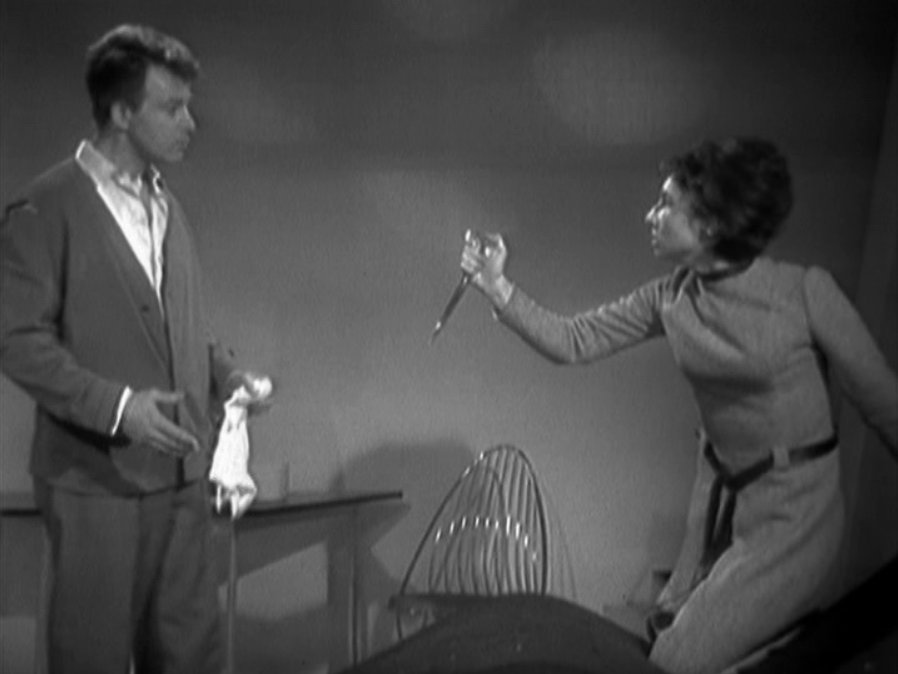
Now back to that scene with Susan and the scissors (which I always mistake for a knife at first). Bloody hell I'd forgotten how well scary and unsettling it is. When Ian comes back into the room and she's just stood there grasping them in her outstretched arm. It's genuinely quite shocking. And then she threatens Ian before completely breaking down and stabbing the chair. It's like something out of Psycho! And it's played well by Ford.

The nightie type clothes that Susan wears after this only help to make her look creepy still. Yet when we see Barbara wearing them a bit later on they don't have the same effect.

At the end of the Daleks we had the Doctor becoming much more like the kind Time Lord we know, but here (for the first episode and some of the second at least) he goes back to being rather unpleasant again. He accuses Barbara and Ian of attacking them and somehow tampering with the ship. He really isn't nice to them and it's good to see that at the end Barbra is still quite unhappy. I noticed how the Doctor never actually apologised to her or Ian. He does say how useful Barbara was and is a lot warmer to them, but he never actually says sorry to them. I think he's a little bit too stubborn to do that.

We do get some nice bits with the Doctor at the end though. The scene when he realises that they are at the start of a new solar system is really good. A great speech (for want of a better word) and good camera work too, slowly zooming in on him stood solitary in front of the console in a shot not like any we've seen of the TARDIS so far. He may have returned to his old self when faced with something he didn't understand at the start but the way he is at the end shows that Barbara and Ian (and even Susan to an extent) are having a positive effect on him.

The Edge of Destruction Episode One score: 8/10
The Brink of Disaster (Episode two) score: 7/10

The average score is 7.5/10

One last thought, the written on fast return button didn't escape me! The thing is none of the other buttons have writing to tell you what they do, that's part of the mystery, so they needn't have written it on just for that button. It isn't quite enough to take you out of the moment but it could have been side stepped completely. Ah well.

Next I'm onto Marco Polo in it's full reconstructed form, which I haven't seen before. It will also be my first reconstruction. I must say I'm a little nervous...